Why FinOps for Machine Learning?
Financial operations isn’t just about cutting costs – it’s a collaborative practice that empowers your team to build sustainable, efficient and scalable AI systems.
Deep Learning Cost Map
A typical deep learning pipeline incurs costs at every stage, from ingesting data to deploying models. FinOps helps identify which stages drive the most expense and where optimisation efforts should focus. The chart below uses anonymised real‑world data to illustrate the cost breakdown across stages: data ingestion ($3.5k), preprocessing ($2.2k), model training ($15k), hyperparameter tuning ($4k) and evaluation ($1k). As you can see, training dominates the budget, consuming about 80% of the total.
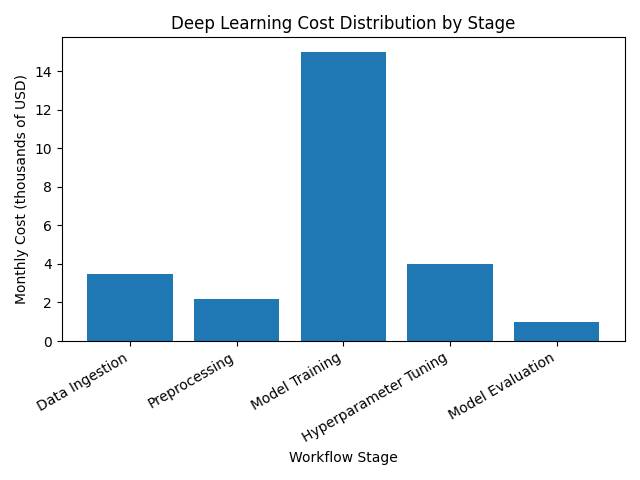
Understanding this distribution allows teams to prioritise right‑sizing, accelerate data pipelines and invest in efficient training techniques.
FinOps Priorities 2025
The State of FinOps 2025 report shows that half of practitioners rank workload optimisation and waste reduction as their number one priority. Cost allocation and visibility come next at around 30%, followed by accurate spend forecasting at 27%. The chart below visualises how practitioners are prioritising their FinOps efforts.
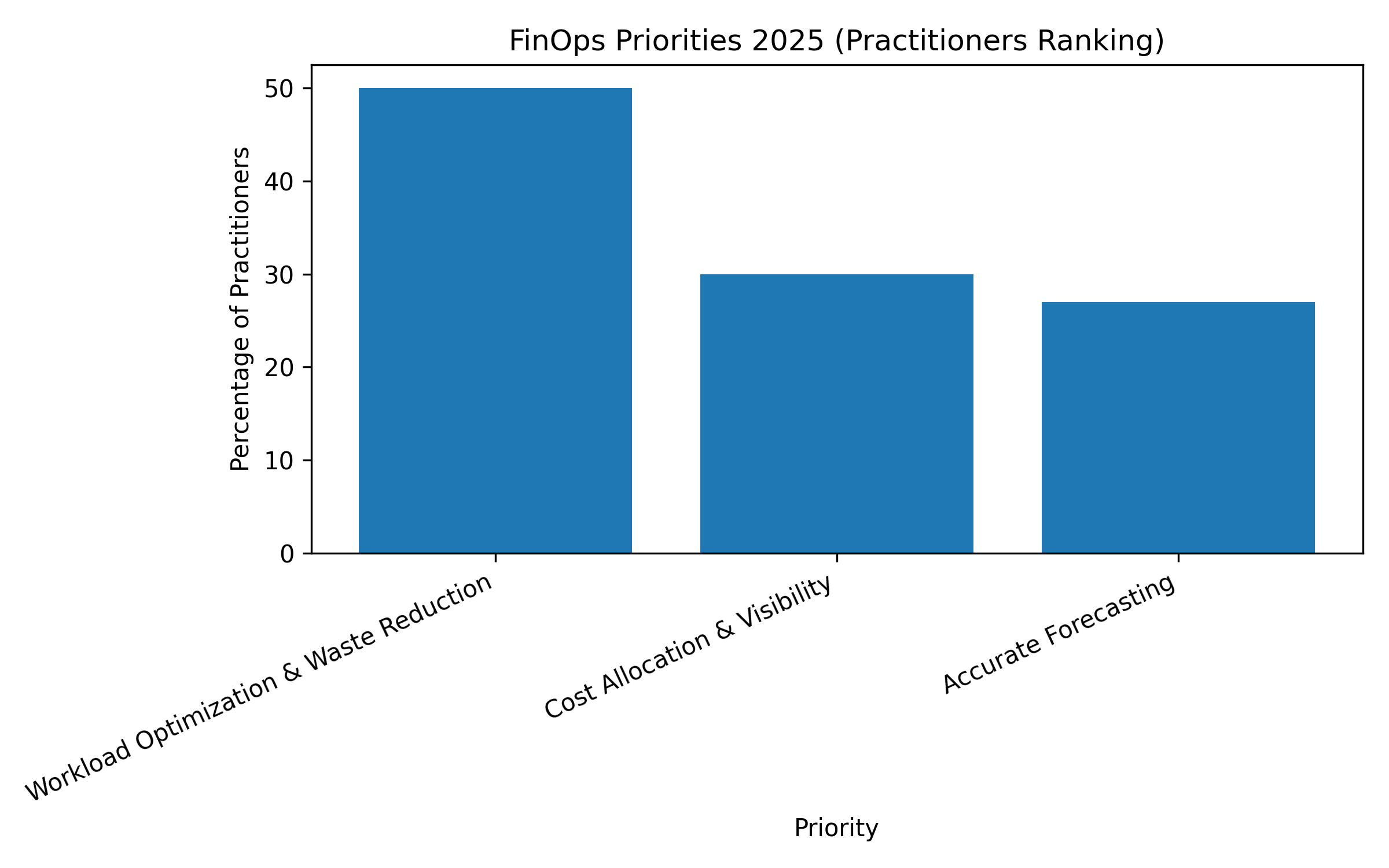
Understanding where FinOps teams focus their efforts helps you align your own initiatives and invest in the right capabilities.
Hidden GPU Waste & Idle Clusters
Many organisations over‑provision their GPU clusters in case training runs need more power. However, leaving advanced accelerators idle burns money quickly. In one FinOps case study, an 8‑GPU cluster cost about $12 k per month but had around 40 % idle time; downsizing to 4 GPUs reduced the bill to roughly $5.5 k with 30 % idle time, while a 2‑GPU cluster cost only about $2 k with 20 % idle. The chart below illustrates how cluster size affects monthly cost and idle percentage.
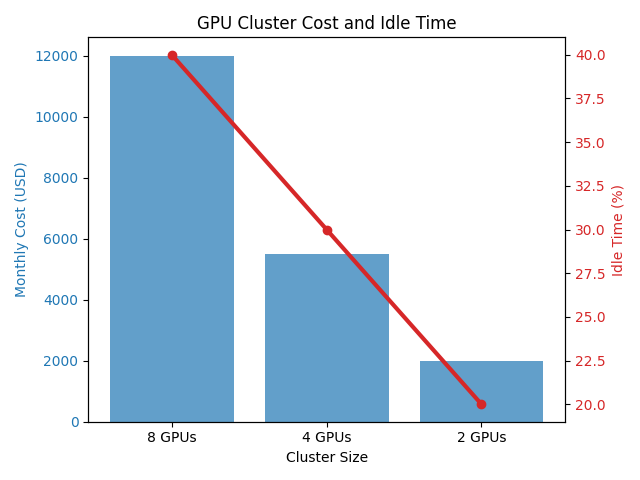
Rightsizing your clusters and eliminating idle hours can immediately free up budget. ML Mind helps you discover these opportunities automatically.
What is FinOps?
FinOps – short for “cloud financial operations” – is the discipline of bringing engineering, finance and product teams together to manage cloud spend. Rather than a pure cost cutting exercise, FinOps encourages transparency, shared ownership and informed decision‑making. According to the FinOps Foundation, practitioners iteratively cycle through three phases:
Inform
Make spend visible and allocate costs to projects and teams. Provide dashboards, reports and forecasting so everyone understands how usage translates into dollars.
Optimize
Identify and act on efficiency opportunities like right‑sizing, reserved capacity, autoscaling and modern architectures. Continuously improve your unit economics.
Operate
Embed cost awareness into daily workflows. Set guardrails, track budgets against actuals, and perform forecasting to stay ahead of surprises.
Why Does FinOps Matter for ML & AI?
Explosive Compute Demand
Training modern models requires massive compute clusters. Research shows that training alone accounts for around 80% of many AI budgets, often reaching $15k per month for a single cluster. Without controls, costs spiral quickly.
High Waste Rates
FinOps surveys estimate 30–35% of cloud spending is wasted due to over‑provisioning and idle resources. In ML pipelines specifically, idle GPU hours, failed runs and repeated experiments compound this waste.
Complex Visibility
Standard cloud dashboards group spend by account, not by individual models or runs. FinOps tools specialised for ML provide the context needed to attribute costs to pipelines, datasets and model versions.
Strategic Priority
In recent FinOps practitioner surveys, workload optimisation and waste reduction were cited as the number one priority. Teams want to innovate faster, but not at the expense of runaway budgets.
How ML Mind Applies FinOps
ML Mind operationalises the FinOps principles for machine learning teams. Our platform delivers transparency (Inform), identifies optimisation opportunities (Optimize) and provides guardrails to enforce budget discipline (Operate).
Transparent Insights
Ingest run data from your pipelines and see utilisation, duration and cost breakdowns by model, dataset and user. Know exactly where your budget is going.
Waste Detection
Built‑in detectors uncover OOM loops, duplicate runs and runs with no artifacts. Spot patterns of waste you would never find through manual auditing.
Guardrails
Create policies to warn, stop or block wasteful runs when confidence exceeds your threshold. Start in dry‑run mode and gradually enforce automatic actions.
Continuous Learning
We iterate with you: as your models and workloads evolve, our recommendation engine surfaces new opportunities to rightsize instances, adjust spending plans and allocate budget to what matters.
Ready to Embrace FinOps?
Discover how much your organisation could save. We take only 10 % of the savings we uncover – there are no upfront fees or commitments. Let us analyse your current spend and show you the results.