Free AI FinOps Audit
Find hidden AI waste before it becomes your default operating cost.
ML Mind audits where AI spend leaks across LLM prompts, RAG context, failed retries, model routing, semantic cache, self-hosted GPU serving and training workflows. The result is a prioritized savings map focused on cost reduction that preserves answer integrity.
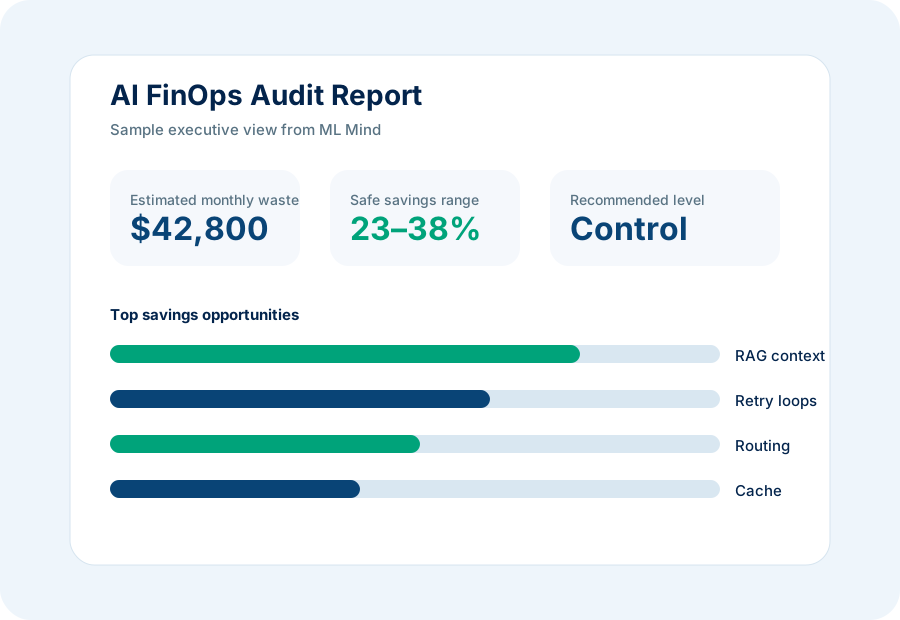
What ML Mind audits
The audit is designed for teams that already use LLM APIs, RAG pipelines, agents, gateways, or self-hosted inference and need to know where spend is leaking.
LLM token waste
Oversized prompts, repeated instructions, avoidable input tokens, noisy outputs and expensive calls that could be handled more efficiently.
RAG context waste
Too many chunks, stale sources, duplicate passages, weak citation value and context that increases cost without improving the answer.
Retry and failure waste
Timeout loops, tool errors, provider failures, quota issues and agentic workflows repeating the same costly mistake.
Routing opportunities
Requests that can move to a cheaper safe model, verified cache, fallback path, or stronger model only when risk requires it.
GPU serving waste
Idle replicas, poor batching, low utilization, cold starts, OOM loops and expensive model placement in self-hosted inference stacks.
Training lifecycle waste
Duplicate experiments, weak validation improvement, avoidable checkpoints and release gates that need cost and quality context.
What you receive
A practical audit brief that finance, platform and AI engineering teams can use together.
Waste source breakdown
Which part of your AI workflow is leaking cost: tokens, RAG, retries, routing, cache, fallback, GPU or training.
Safe savings estimate
Savings are framed as integrity-adjusted: cost reduction is useful only when answer quality, citations and risk controls survive.
Deployment recommendation
Start with logs, telemetry, pre-model optimization, gateway control, ModelOps, or lifecycle governance based on your stack.
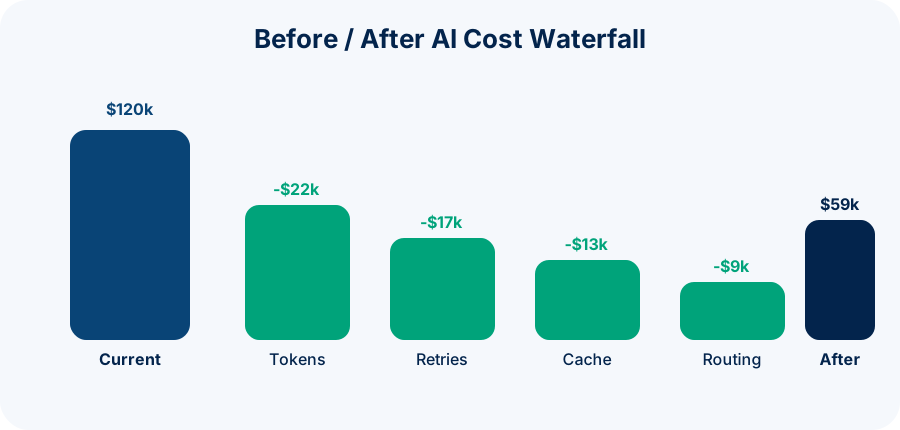
A low-friction starting point
1. Start with what you have
Billing exports, provider usage reports, token counts, request traces, retry logs, RAG retrieval samples, or GPU utilization summaries.
2. Map waste to controls
Each waste source is mapped to the least invasive control first: visibility, pre-model optimization, gateway policy, ModelOps, or lifecycle governance.
3. Prioritize by safe ROI
ML Mind prioritizes savings that are technically feasible, commercially meaningful and unlikely to damage answer integrity.
Request your free audit
Free AI FinOps Audit
Start with a practical AI waste review
Share your approximate workload profile. ML Mind can begin from reports or telemetry before any gateway or control-layer deployment is required.
- Identify your largest AI cost leaks.
- Estimate safe monthly and annual savings.
- Recommend the right deployment level.
Frequently asked questions
Do we need to expose prompts?
No. The first audit can start from aggregate logs, billing exports, token counts, retry patterns and architecture review. Deeper control is optional.
Is this only for OpenAI bills?
No. ML Mind is designed for LLM providers, RAG systems, AI gateways, self-hosted inference, GPU clusters and training workflows.
What makes savings safe?
ML Mind separates blind cost cutting from integrity-adjusted savings. Critical numbers, dates, citations, policies and risk requirements remain protected.
Turn this page into action
ML Mind is designed to move from content to evidence: simulate your workload, generate a savings report, then request a structured AI FinOps audit.
Request your free AI FinOps audit
Use this lightweight form to prepare a first review. The static site opens a pre-filled email so no lead is lost before backend integration.