Market category guide
AI Observability vs AI Gateway vs AI FinOps vs ML Mind
Most tools show AI activity or route traffic. ML Mind connects visibility, control and integrity-adjusted savings so AI teams can reduce cost without blindly damaging answer quality.
| Category | What it does well | Where it helps | Common gap | ML Mind position |
|---|---|---|---|---|
| AI Observability | Traces, latency, errors, token cost | Understanding production behavior | Often discovers waste after it happens | ML Mind uses observability as the first step, then moves toward control |
| AI Gateway | Routing, provider abstraction, caching, rate limits | Request-path control | May not measure savings against answer integrity | ML Mind focuses on cheapest safe model, verified cache and smart fallback |
| Cloud FinOps | Budgeting, allocation, cloud bill visibility | Finance governance | Does not see prompt, RAG, retry or model behavior | ML Mind adds AI workflow-level savings logic |
| Prompt compression | Reducing token count | Input cost reduction | Can remove critical facts if used blindly | ML Mind protects numbers, dates, citations and source-sensitive facts |
The core difference
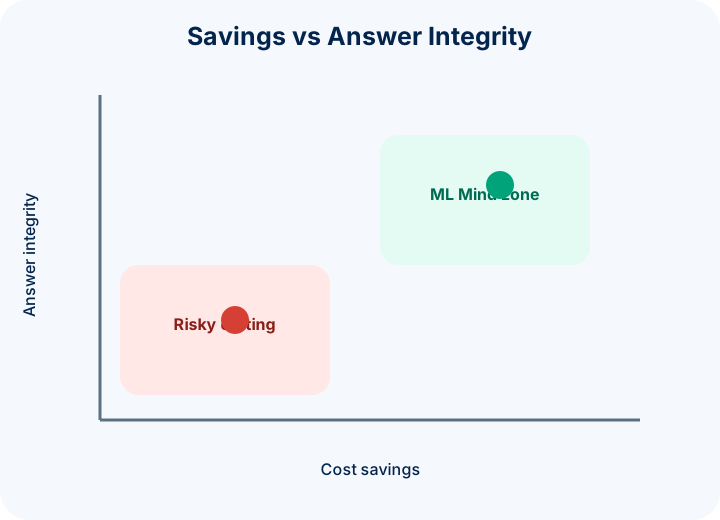
ML Mind does not treat every dollar saved as success. Savings only matter when the answer remains reliable, current, policy-safe and defensible.
The metric: integrity-adjusted savings — cost reduction after accounting for fallback, risk and answer degradation.
Free AI FinOps Audit
Compare ML Mind against your current stack
Request a free audit to see whether your existing observability, gateway or FinOps tools are finding controllable savings.